Field of Fire
Fire & BloodThe Field of Fire was the decisive battle between Aegon Targaryen and the allied western kings Mern IX Gardener and Loren I Lannister. Fought on open, dry plains south of the Blackwater, it ended the Gardeners’ rule and opened the way for Aegon to impose his authority across the Reach and the Westerlands.
The Two Kings Assemble
Mern and Loren joined forces against Aegon, gathering at Goldengrove before marching north. Their host numbered fifty-five thousand, including more than five thousand mounted knights and some six hundred lords. Mern called it his iron fist, and his four sons and two young grandsons accompanied him. The size of the army was itself a constraint: it could not remain long in one place without consuming the surrounding countryside, so the allied kings moved out promptly.
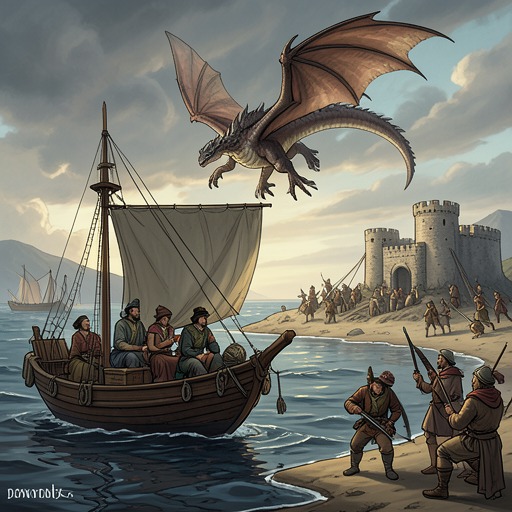
Aegon learned of their advance while encamped beside the Gods Eye. He had only about a fifth as many men, many of them riverlords whose allegiance to House Targaryen was recent and untested. His smaller force could move faster, however. At Stoney Sept, his queens, Rhaenys and Visenya, joined him with their dragons; Rhaenys came from Storm’s End, while Visenya arrived from Crackclaw Point, where local lords had pledged fealty. The three Targaryens watched from above as Aegon’s army crossed the headwaters of the Blackwater Rush and raced south to meet the western host.
Deployment and the Battle
The armies met on broad plains south of the Blackwater, near the route the goldroad would later follow. The ground offered no natural barriers, and the weather favored the western kings’ cavalry: it was firm and dry after more than a fortnight without rain. Their scouts reported that they outnumbered Aegon’s force five to one, with an even greater advantage in lords and knights. Mern, whose host was half again as large as Loren’s, took command of the center. His son and heir, Edmund, led the vanguard; Loren and his knights formed the right, and Lord Oakheart commanded the left. The allied plan was to sweep around Aegon’s flanks and strike his rear while Mern’s armored wedge broke through the center.
Aegon arranged his smaller force in a rough crescent, with spears and pikes at the front, archers and crossbowmen behind them, and light cavalry on both flanks. He entrusted command on the ground to Jon Mooton, Lord of Maidenpool, one of the earliest former opponents to join his cause. Aegon himself meant to fight from the air beside his queens. He had also taken note of the dry, tall grass and ripe wheat surrounding the armies. The terrain that looked so favorable to a massed charge offered another possibility to the dragons.
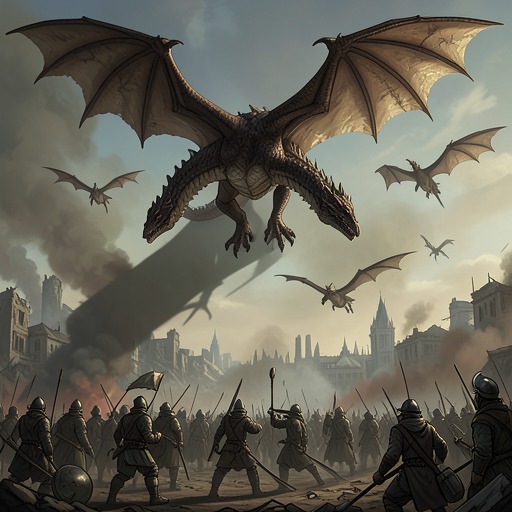
The Targaryens waited until the western army sounded its trumpets and advanced beneath its banners. Mern led the charge toward the center on a golden stallion, accompanied by his son Gawen, who carried the Gardener banner. The Gardeners and Lannisters pressed through the arrows and drove back Aegon’s spearmen, disrupting their ranks. By then, however, Aegon and his sisters were airborne. Riding Balerion, Aegon attacked from above, while Rhaenys and Visenya set fires behind and upwind of the advancing host. The dry fields caught quickly; wind carried the flames and smoke into the western ranks, and the fire and confusion broke the momentum of the charge. Mooton’s troops, positioned upwind, met those who emerged from the burning fields with bows and spears.
The battle became known as the Field of Fire. More than four thousand men died in the flames, and another thousand were killed by weapons; tens of thousands suffered burns, some severe enough to leave lifelong scars. Mern died with his sons, grandsons, brothers, cousins, and other relatives. A nephew survived him by three days, and with his death House Gardener’s line ended. Loren escaped through the fire and smoke after recognizing that the battle was lost. The Targaryens, by contrast, lost fewer than a hundred men; Visenya was struck in the shoulder by an arrow but recovered.
Submission and the End of House Gardener
The military victory became a political settlement the following day. Loren Lannister was captured and surrendered his sword and crown to Aegon, kneeling in homage. Aegon then upheld the policy he had shown toward defeated lords who submitted: he raised Loren and confirmed him in his lands and lordship, recognizing him as Lord of Casterly Rock and Warden of the West. Loren’s surviving bannermen followed his example, as did many of the Reach lords who had lived through the battle. The surrender converted a battlefield defeat into allegiance without displacing the western lord who had yielded.
The outcome was harsher for House Gardener. Mern IX Gardener and his close male kin died in the battle, and the only nephew said to have survived died three days later. With that death, the ruling line of House Gardener ended. The contrast between Loren’s restored lordship and the extinction of the Gardeners’ line shows how the battle reshaped the political order: submission allowed one defeated king to retain power, while the other kingdom’s ruling house disappeared.
Aegon’s victory did not itself secure every western and southern stronghold. He left his sisters and marched for Highgarden, seeking to prevent another claimant from taking it. There he found the castle held by its steward, Harlan Tyrell, whose ancestors had served the Gardeners for generations. Harlan surrendered the keys without resistance and pledged his support to Aegon. In return, Aegon granted him Highgarden and its domains, made him Warden of the South and Lord Paramount of the Mander, and gave him authority over the former vassals of House Gardener. The battle had destroyed the old ruling line; the surrender at Highgarden established a new one.
From Battlefield Victory to Royal Legitimacy
The Field of Fire also became a foundation for Aegon’s public kingship. After the dragons fed on the dead, he ordered the fallen soldiers’ swords gathered and sent downriver. His earlier crowning at the mouth of the Blackwater had been witnessed by only a handful of lords; after the conquest had carried him to Oldtown, the High Septon anointed him with the seven oils in the Starry Sept, and hundreds of lords attended. Tens of thousands cheered as Aegon rode through the city on Balerion. Maesters and archmaesters from the Citadel were among the witnesses, and the Oldtown ceremony—not the first crowning—came to mark the beginning of his reign. The battle’s destruction thus fed into a broader transformation: Aegon’s victory over the western kings helped make the claim of one ruler over the Seven Kingdoms a political reality, even though Dorne had not submitted.